
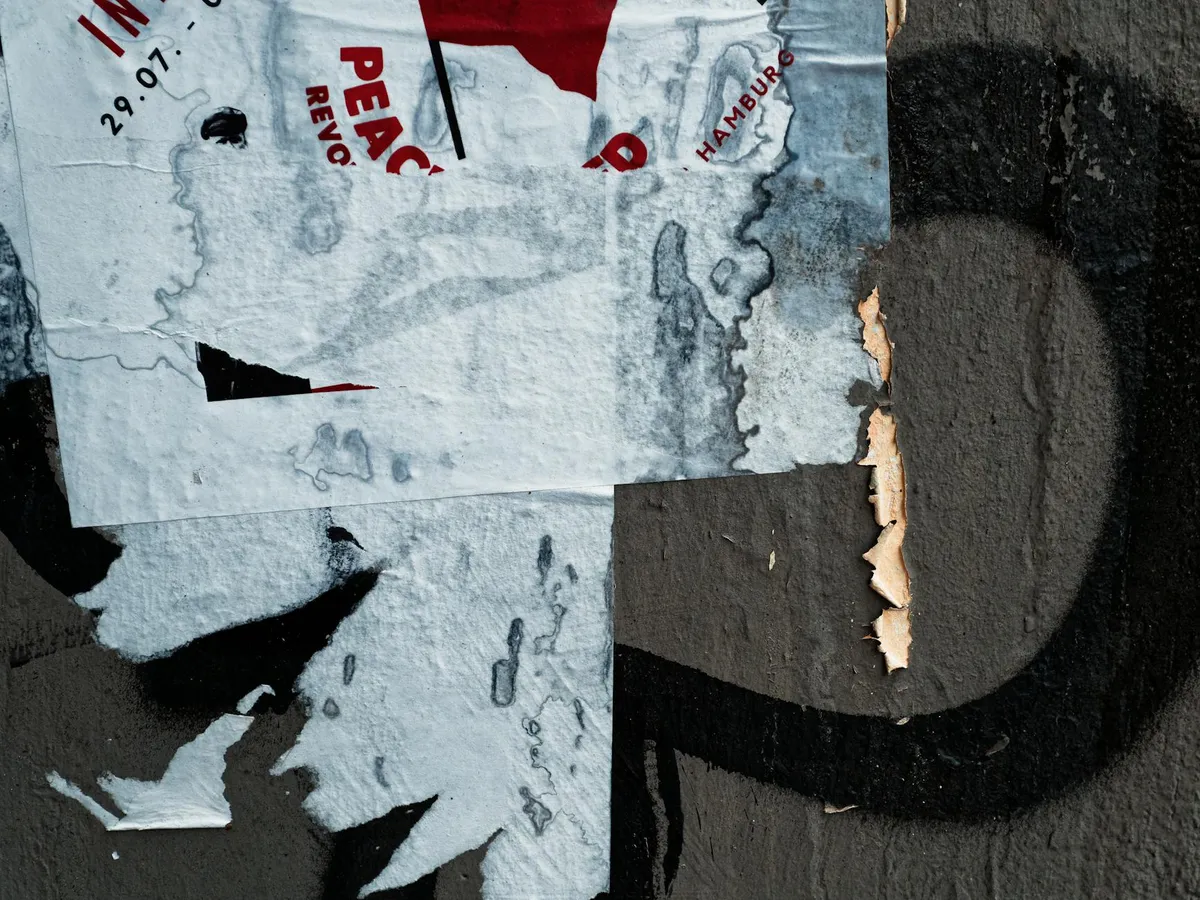
Wheatpaste is the most-ephemeral of the major street art forms. Paper applied to a wall with a flour-and-water adhesive begins deteriorating almost immediately — torn by wind, washed by rain, peeled by passersby, painted over by property owners. The typical wheatpaste piece has a working life of weeks. Some pieces survive months in protected locations; few survive years. This brevity is not an accident or a limitation; it is constitutive of what the form is and what it can do. This essay is about what the brief half-life produces and what wheatpaste offers that more-durable forms cannot.
The technique
The basic technique is straightforward. The artist creates an image — typically printed but sometimes hand-drawn — on paper. The paper is brought to the site. A flour-and-water paste is applied to the wall, the paper is positioned and pressed in place, and another layer of paste is applied over the paper. The whole assembly dries within a few hours; the paper bonds to the wall with surprising tenacity.
The simplicity of the technique is part of what shaped the form's character. Wheatpaste requires almost no specialized equipment beyond what can be carried in a small bag. The work can be installed quickly — typically in minutes — which permits placement in locations where extended presence would be impractical or risky. The cost per piece is minimal; the artist can produce many works for the cost of a single elaborate stencil or mural.
These properties have made wheatpaste attractive to artists working in particular modes — political artists who need to deploy messaging across many locations quickly; artists who want to populate cities with imagery rather than create singular monumental works; artists who are explicitly engaging with ephemerality as part of their practice.
The aesthetic of disappearance
Wheatpaste pieces age visibly. The paper edges peel within days. The colors fade in sun-exposed locations. Wind catches torn corners and rips them progressively larger. Rain causes the paper to bubble, then to dissolve. Passersby — often without considering it as defacement — peel pieces partially or completely off the wall.
This aging is the form's aesthetic signature. A pristine wheatpaste piece, fresh on the wall, looks complete in one way. The same piece three weeks later, weathered and partially torn, looks complete in a different way. The work continues to develop after its creation, with the city itself as a co-author of the final composition.
Photographers documenting wheatpaste work often photograph pieces multiple times across their lifespan. The same piece on day one and day thirty are different works in some respects; both are recognizable as the same piece, but each has properties the other doesn't. Some photographers prefer the pristine state; others prefer the weathered state; the truth is that both are valid stages of a work that exists across time rather than at a single moment.
What ephemerality offers
The brief half-life of wheatpaste offers several things that more-durable forms cannot.
Lower commitment from the audience. A piece that will be gone in weeks doesn't demand the same kind of attention that a permanent mural does. Viewers can engage with it briefly, knowing they don't need to study it exhaustively or remember it in detail. The lower commitment paradoxically produces more comfortable viewing for many people.
Permission for political risk. A wheatpaste piece making a controversial political statement is gone before it can become a long-term liability for anyone. The painter is less exposed; the property owner is less burdened; the political risk is contained by the form's ephemerality. Some of the strongest political street art uses wheatpaste for this reason.
Productive collaboration with the city. The city participates in completing the work. The torn corner that exposes a layer of older posters; the weathering that reveals brick beneath; the partial peeling that reveals the wall's texture — these are not damage but composition. The form acknowledges that the city is not a passive surface but an active participant.
The weight of impermanence as theme. Wheatpaste work that addresses themes of impermanence, mortality, urban change, or political transience does so with a form that itself embodies these themes. The medium reinforces the message in ways that durable media cannot.
The major practitioners
The wheatpaste tradition has produced a few practitioners whose work has shaped how the form developed.
Shepard Fairey — initially through the Obey Giant project — used wheatpaste extensively across the 1990s and 2000s. His work demonstrated that wheatpaste could function at scale, with consistent imagery deployed across many cities and producing recognizable visual identity over time. His later work moved toward more-durable forms, but the wheatpaste origins shaped his sensibility throughout.
JR — the French artist whose large-scale photographic portraits have been wheatpasted on walls and surfaces in cities across the world — has demonstrated that wheatpaste can support work at architectural scale. His pieces sometimes cover entire building facades, executed in wheatpaste despite the monumental scope. The ephemeral nature of the work, given the scale of the production effort, raises distinctive questions about what permanence is for.
Faile — the Brooklyn-based collective — has produced wheatpaste work for two decades that combines pop-cultural imagery with painterly techniques. Their work has moved between street and gallery contexts in ways that test the form's relationship to institutional art.
Swoon — Caledonia Curry — produces wheatpaste figures of remarkable detail and emotional weight. Her work demonstrates that wheatpaste can support fine-art ambitions while retaining its street-form character.
These four are far from the complete list of significant practitioners, but they suggest the range of what the form has supported.
The documentation question
Because wheatpaste pieces disappear, documentation becomes part of how the work participates in cultural memory. Photographs become the durable record of the ephemeral work. The relationship between the original wheatpaste and its photographic documentation is complex; the photograph is not the work but it is what survives.
This produces interesting consequences. Wheatpaste artists who document their work systematically participate in the longer cultural conversation about the form; artists who don't may produce excellent work that is largely lost. The documentation itself becomes part of the practice.
For viewers wanting to encounter wheatpaste work historically, the documentation is now the primary access point. The actual pieces are mostly gone. The photographs preserve what would otherwise be unavailable. The relationship to the work is inevitably mediated; this is part of what wheatpaste's ephemerality has produced.
Encountering wheatpaste in cities
For viewers wanting to encounter wheatpaste work currently, the encounter requires patience and walking. Pieces appear and disappear continuously; the wheatpaste scene in any given city is a moving target. Areas with high concentrations of street art generally have wheatpaste work mixed in with other forms; pure wheatpaste-focused areas are rarer.
Carrying a phone camera and documenting what you encounter is part of how engaged viewers participate in the form. The photograph you take of a wheatpaste piece today may be the only record of that piece a year from now. The amateur documentation network around street art has become substantial; it is part of how the form continues to function despite its ephemerality.
The closing observation
Wheatpaste is the form that takes ephemerality most seriously. Other street art forms can persist for years; wheatpaste is structured around its own disappearance. This is a significant aesthetic choice with significant consequences for what the form can do.
The work that uses these consequences well — that engages with ephemerality as theme, that collaborates with the city in its own decomposition, that accepts the brevity as constitutive rather than as limitation — produces effects that more-durable forms cannot replicate. Worth understanding the form on its own terms rather than measuring it against the durability standards of other forms.
The piece that's torn and weathered after three weeks isn't a damaged piece; it's a complete piece in its later stage. Viewing it that way is part of what the form asks of its audience.