
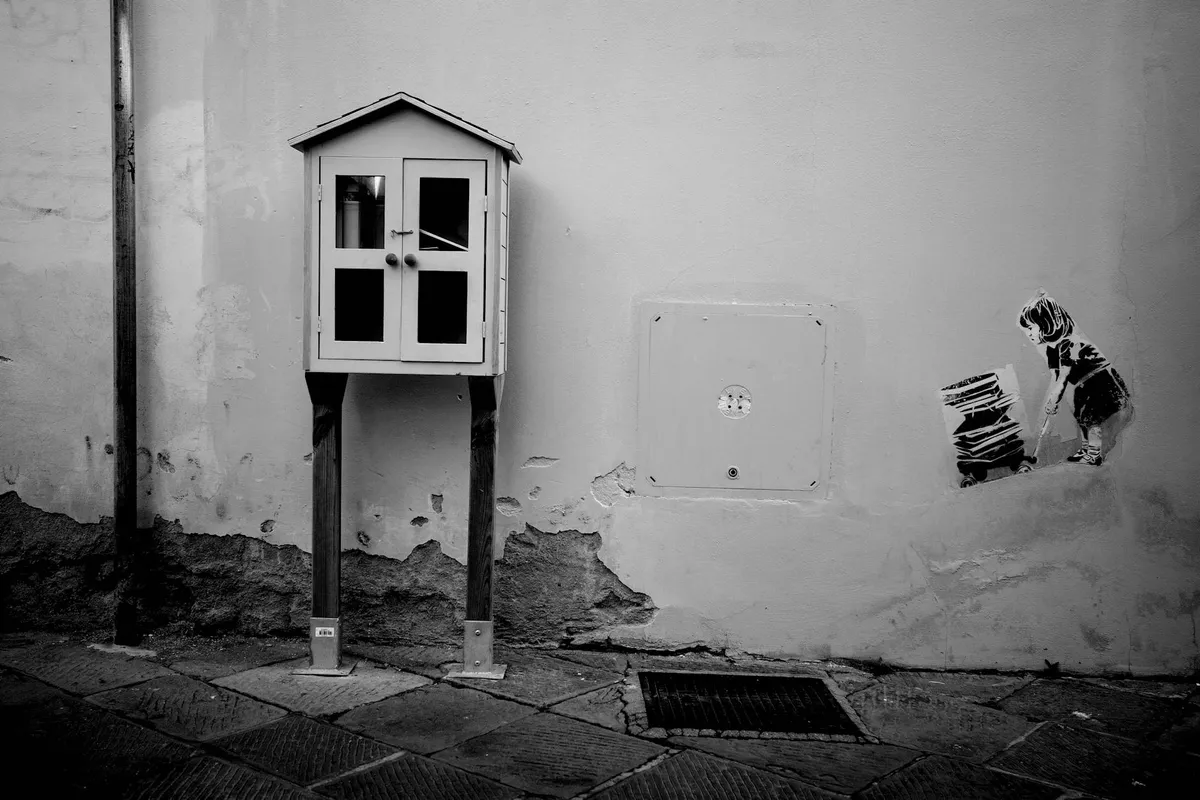
The stencil tradition in street art is, in popular consciousness, almost entirely associated with one artist. This is misleading both about the tradition and about the artist. The stencil tradition was already four decades deep when Banksy began working in it; he is the most-famous practitioner but neither its originator nor its most-influential developer. Understanding the deeper history makes the contemporary work more legible. This essay sketches that history.
The political origins (1960s-1970s)
Stencil work in the contemporary urban tradition begins in the political movements of the 1960s. The technique was attractive to organized political groups for practical reasons: a stencil could be cut once and used to produce many identical messages quickly across a city. The labor was distributable; multiple participants could spray the same message on different walls without coordination beyond cutting the stencil.
French situationist movements in the late 1960s used stencils extensively for political messaging during the May 1968 unrest in Paris. Anti-Vietnam-War movements in the United States used stencils in major cities. Italian autonomist movements throughout the 1970s used stencils for political organizing across northern Italian cities. Argentine and Chilean opposition movements during the military dictatorships used stencils for resistance messaging that could be deployed quickly and abandoned before authorities could trace it.
This political origin shaped the form in ways that persist. The stencil retains an inherent association with political messaging that other street-art techniques don't have to the same degree. The technique's capacity for rapid repetition continues to make it attractive to artists working in political modes.
The artistic emergence (1980s)
The shift from purely political stenciling to recognizably artistic stenciling happened across the 1980s, with multiple parallel developments in different cities.
In Paris, Blek le Rat (Xavier Prou) began producing stenciled rats and stenciled human figures across the city in 1981. His work explicitly drew on the political stencil tradition while developing it toward more-personal artistic expression. He is widely credited as the first artist to use stencils in a way that could be called street art rather than political messaging. His influence on every subsequent stencil artist, including Banksy, is direct and acknowledged.
In New York, John Fekner had been producing stenciled environmental and political messages since the 1970s, with a turn toward more-conceptual work in the 1980s. His messaging on abandoned buildings in the South Bronx documented urban decay through stenciled phrases that engaged directly with the surrounding architecture.
In Buenos Aires, the stencil tradition that had developed during the dictatorship continued into the 1980s in modified form, eventually producing a contemporary stencil scene that remains among the most-developed in any city.
These parallel developments produced, by the late 1980s, a recognizable tradition of stencil work as artistic practice rather than purely political messaging.
The 1990s consolidation
The 1990s saw the stencil tradition consolidate across multiple cities. New artists emerged who were aware of the tradition's prior history and worked within it consciously. The technique developed visually — multi-layer stencils permitting greater detail, large-format stencils permitting larger-scale work, stencil-and-spray hybrid approaches.
Key figures of this period include C215 in France, Jef Aérosol in France, Logan Hicks in the United States, and the Argentine collective work that continued developing in Buenos Aires. Each contributed innovations that the next generation built on.
The work of this period is less-known to general audiences than the work that followed but is essential context for understanding what came next. The technical innovations and stylistic conventions that Banksy and his contemporaries used in the 2000s were established by these earlier artists.
The Banksy era (2000s-present)
Banksy began producing stenciled work in Bristol in the late 1990s and rose to international prominence across the 2000s. His work is distinctive in several respects: the consistent satirical political voice, the technical sophistication of the stencils, the systematic documentation through books and a website, and the eventual movement of his work into gallery and auction contexts.
His prominence has had paradoxical effects on the stencil tradition. On one hand, he brought attention to a form that had been largely invisible to mainstream audiences; many subsequent practitioners have found audiences and economic support that wouldn't have existed without the visibility he produced. On the other hand, his prominence has obscured the tradition he emerged from; many viewers encounter stencil work primarily through him and assume the form was largely his invention.
The Banksy era has also produced a generation of imitators whose work is technically competent but artistically derivative. The "Banksy-style" stencil — satirical, monochromatic with one color accent, featuring an unexpected juxtaposition — has become a recognizable category that's frequently produced without significant variation. The interesting contemporary work is generally not the Banksy-style work; it is the work that engages with the stencil tradition while developing it in new directions.
The contemporary tradition
The contemporary stencil tradition, taken as a whole, is more diverse than its public reputation suggests. Practitioners are working across multiple visual approaches:
- Large-scale photorealistic portraiture (C215, Logan Hicks)
- Multi-layer stencil work that approaches painted detail (Jef Aérosol, Eddie Colla)
- Politically engaged work that maintains the form's original political dimension
- Conceptual work that uses stencils as one element among others
- Hybrid work that combines stenciling with other techniques
This diversity is invisible to viewers whose understanding of the tradition is limited to its most-famous practitioner. Engaging with the tradition more deeply reveals a form that's richer than the reputation suggests.
What the longer history makes visible
Knowing the longer history changes how individual contemporary works read. A stencil that uses high-contrast monochrome with a single color accent is now visibly drawing on a convention developed in the 1990s; it is not a novel choice. A stencil that addresses political content is participating in a sixty-year tradition; the political dimension is not incidental but constitutive.
The longer history also makes visible what is genuinely innovative in contemporary work. Innovations that are obvious against the deeper context become invisible without it; viewers without the history credit innovations to artists who are using established conventions and miss the actually-innovative choices that other artists are making.
This is the case for any artistic tradition. What looks original to viewers without context is often convention; what looks conventional to viewers without context is often innovation. The work of looking carefully and reading widely is what distinguishes thoughtful viewing from impressionistic viewing.
The recommendation
For viewers wanting to engage with stencil work as a tradition rather than a single artist's practice, the path is straightforward: read about the artists who preceded Banksy. Look at images of their work. Notice the conventions they established and the innovations they introduced. Then look at contemporary work with that history in mind.
The contemporary work becomes both more interesting and more legible. The artists whose work engages seriously with the tradition stand out; the artists whose work is derivative becomes visible as such. The conversation that the form is having with itself across decades becomes part of what you're looking at, not an invisible context that goes unnoticed.
The tradition rewards the deeper reading. Worth doing.