Mexico City has one of the deepest mural traditions of any city in the world. The lineage is continuous from the post-revolutionary muralism of the 1920s — Diego Rivera, José Clemente Orozco, David Alfaro Siqueiros — through the various intermediate generations to the contemporary mural scene that flourishes across the city today. Few other cities have a mural tradition that extends back a full century with this much continuity. This essay is about what makes the Mexico City tradition distinctive and what it has continued to offer the form.
The post-revolutionary origins
The contemporary Mexico City mural tradition begins in the years following the Mexican Revolution (1910-1920). The new government, under José Vasconcelos as Minister of Education from 1921, commissioned large-scale murals on public buildings as part of a deliberate effort to construct a national visual culture that addressed the largely illiterate population. Public walls were chosen as the medium because public walls could reach people who could not read books.
The three figures most associated with this initial period — Rivera, Orozco, and Siqueiros — produced work that was technically ambitious, ideologically committed, and intended to be permanently part of Mexico City's public spaces. The murals at the Secretaría de Educación Pública, the Palacio Nacional, and the Polyforum Cultural Siqueiros remain accessible today and continue to shape how Mexicans encounter their own history.
This origin matters for understanding everything that follows. The tradition was conceived from the beginning as a public address, as politically engaged, and as monumental in scale. Subsequent generations have inherited and adapted these elements; even when contemporary murals depart from the political content of the original tradition, they typically retain the public-address orientation and the willingness to work at scale.
The intermediate decades
Between the post-revolutionary generation and the contemporary scene, Mexico City's mural tradition went through various transformations. The 1940s and 1950s saw continued public commissions but with a gradual softening of explicit political content. The 1960s and 1970s saw the emergence of a generation of muralists who worked outside the official patronage system, producing work in neighborhoods rather than at government buildings.
The 1980s and 1990s saw the tradition adapt to changing economic conditions. Public funding for mural commissions declined; private patronage emerged in different forms; community-organized mural projects in working-class neighborhoods sustained the form when official patronage was unavailable.
This intermediate history is less-documented than either the founding generation or the contemporary scene but is essential to understanding the continuity. The tradition didn't pause and restart; it transformed continuously, with each generation maintaining elements of the prior generations while adapting to new conditions.
The contemporary scene
The contemporary Mexico City mural scene is among the most-developed in any city in the world. Multiple distinct strands coexist:
The institutional muralists who work in the direct lineage of the post-revolutionary tradition, often producing politically engaged work commissioned by government agencies, universities, or cultural institutions. The work is technically sophisticated and explicitly continues the tradition.
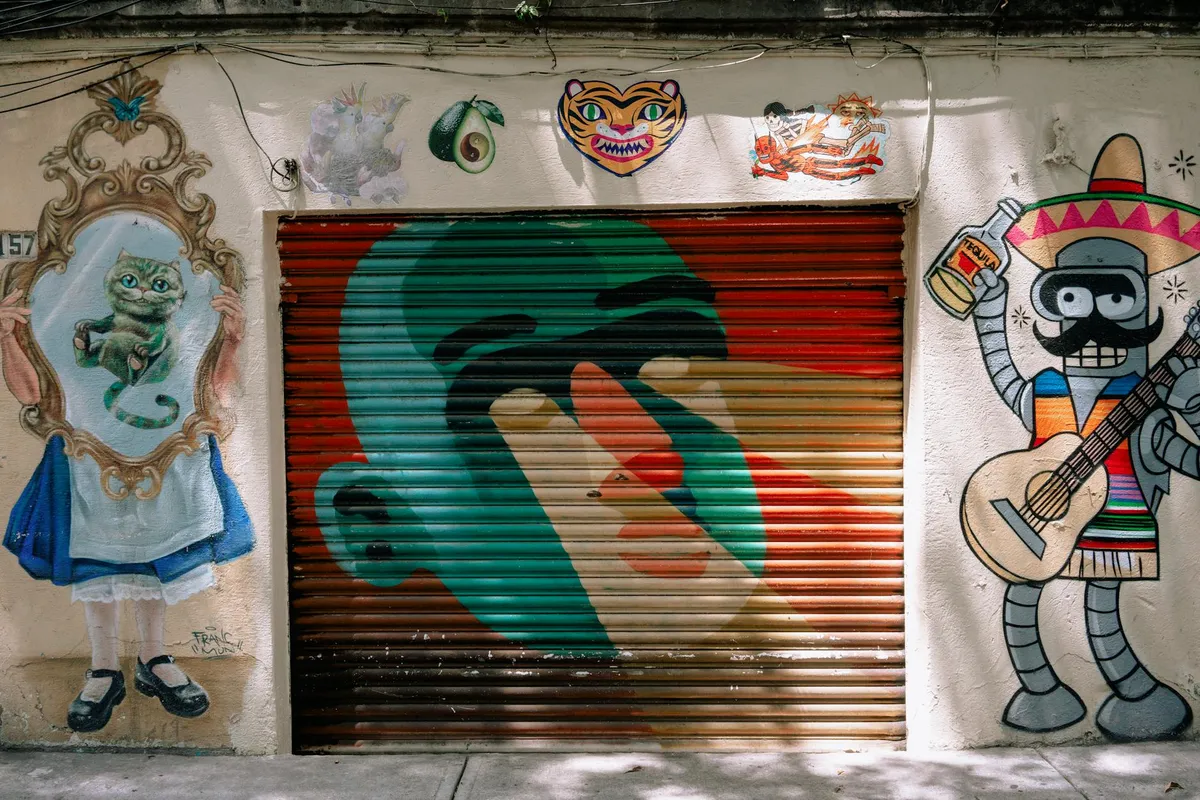
The neighborhood muralists who work in specific neighborhoods, often in collaboration with local communities. The work addresses community-specific concerns and is shaped by community input. This strand sustains the tradition's public-address dimension at a hyperlocal scale.
The international street-art-style muralists who participate in the global street-art conversation while working in Mexico City. The work uses contemporary international visual conventions while sometimes engaging with Mexican specificity.
The festival muralists who appear during organized mural festivals and commissions, typically producing large-scale work in concentrated time periods.
These strands overlap and inform each other. The same artist may work across multiple strands depending on the project. The diversity is the strength of the contemporary scene; no single mode dominates.
What makes the tradition distinctive
Several features distinguish the Mexico City tradition from mural traditions in other cities:
Continuity
The tradition has not been broken. There are mural artists working in Mexico City today who can trace their training and influences in unbroken lines back to the post-revolutionary period. This continuity produces a depth that newer mural traditions in other cities cannot match.
Scale
Mexico City murals tend to be large. The post-revolutionary tradition normalized monumental scale; contemporary work continues this. A "small" mural in Mexico City is often larger than a major commissioned work in cities without the same tradition.
Public address
The tradition retains its orientation toward public address. Murals are made for the people who walk past them, not for gallery audiences. This orientation shapes what the work looks like and what it does.
Political memory
The political dimension of the original tradition persists. Even murals that aren't explicitly political often draw on the political-mural visual conventions established by Rivera, Orozco, and Siqueiros. The political memory is part of how the form reads in this city.
Community embedding
The tradition is embedded in communities in ways that mural traditions in other cities often aren't. Neighborhood-organized mural projects, ongoing dialogue between artists and the people who live with their work, the assumption that murals are part of community infrastructure rather than imposed decoration.
The rest of Mexico
The Mexico City tradition is not isolated. It has influenced and been influenced by mural traditions in other Mexican cities — Oaxaca, Guadalajara, Puebla, and many smaller cities each have their own mural cultures. The relationships between these traditions and the capital's tradition are complex; Mexico City is influential but not dominant. The fuller story of Mexican muralism extends well beyond the capital.
For viewers seriously engaging with Mexican mural culture, multiple cities reward attention. Oaxaca's mural scene, in particular, has developed a distinctive character that is at once influenced by and independent of the capital's tradition.
What the tradition offers other cities
The Mexico City tradition offers an example of what a sustained mural culture looks like. The continuity, the public address, the community embedding, the political memory — these are achievable in other cities, but they require the kind of long investment that Mexico City's tradition exemplifies.
Cities trying to develop their own mural cultures often look to Mexico City as a model. The model is real but cannot be transplanted directly. The tradition's strengths emerged from specific historical conditions — the post-revolutionary state's investment, the intervening generations' adaptations, the community embedding that took decades to develop. New mural cultures in other cities can learn from the example without expecting to replicate it on shorter timescales.
Visiting
For viewers interested in encountering the tradition directly, a few routes through the city offer entry points:
The post-revolutionary murals in the Centro Histórico (Palacio Nacional, Secretaría de Educación Pública, Antiguo Colegio de San Ildefonso) provide grounding in the founding generation. The Polyforum Cultural Siqueiros offers immersive engagement with one of the major figures.
The neighborhood mural scenes in Roma, Condesa, Coyoacán, and several working-class neighborhoods on the city's periphery show the contemporary tradition operating at street level.
The festival murals — particularly those produced by the All City Canvas events of the 2010s and similar more recent programs — demonstrate the international street-art conversation happening within the Mexico City context.
A few days of careful walking, with attention to what has been here for nearly a century alongside what was made last year, offers an experience of artistic continuity that few cities can match.
The closing observation
Mexico City's mural tradition is one of the few sustained public art traditions that has continued nearly unbroken for a century. Few cultural traditions of any kind sustain themselves at this duration with this much vitality. Worth taking seriously, both for what the tradition itself offers and for what it makes visible about what sustained public art is and what it can do.
The walls in Mexico City have been talking for a long time. They're still talking.